INTRODUCTION
A three-day workshop titled “Foundation of Innovation” was organized from 16 to 18 February 2026 under the aegis of the Career Development Centre. The workshop aimed
to develop entrepreneurial thinking, innovation capabilities, and problem-solving skills among participants. Through expert sessions, discussions, and practical activities,
participants were introduced to the fundamentals of entrepreneurship, innovation
processes, design thinking, and business model development. The workshop emphasized transforming ideas into practical solutions that create both social and economic value.
Day 1: Entrepreneurial Mindset, Innovation, and Opportunity Recognition
The first day of the workshop focused on developing the entrepreneurial mindset and understanding the innovation process.
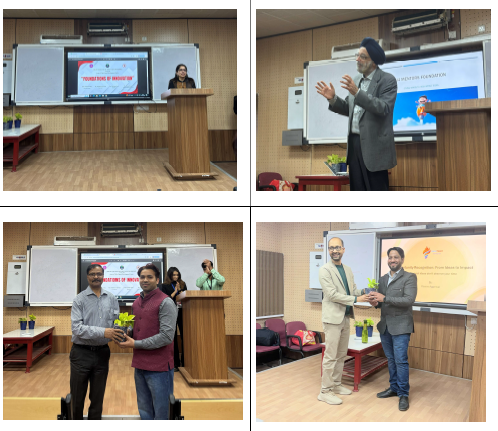
The keynote session “Entrepreneur DNA & Mindset Development” was delivered by Dr.Rajbir Singh. The session emphasized that entrepreneurship begins with clarity of purpose, discipline, and persistence in execution, rather than simply having a unique idea.
Participants were introduced to the LUV Test (Large, Urgent, Valuable) for evaluating business ideas and were guided through the entrepreneurial journey from idea generation to feasibility, prototyping, launching, and scaling.
The second session, “Implementing Ideas: From Innovation to Impact,” was conducted by Prof. Ravinder Kaur. The session discussed different forms of innovation such as incremental, architectural, disruptive, and radical innovation, and highlighted that innovation is a continuous and iterative process involving idea generation, testing, and improvement. Real-life examples were discussed to demonstrate how everyday problems can inspire meaningful innovations.
The third session, “Opportunity Recognition – From Idea to Impact,” was conducted by Gourav Aggarwal. The session explained how entrepreneurial opportunities emerge at the intersection of problems, capabilities, and timing. Participants engaged in discussions and activities to identify real-world problems and convert them into opportunity statements that could potentially lead to viable entrepreneurial ventures.
Day 2: Empathy, User Research, and Ideation
The second day of the workshop emphasized user-centered thinking and research methods in entrepreneurship.
The first session was conducted by Prof. Ravinder Kaur, who discussed the importance of understanding users and identifying their real needs before developing solutions. The session highlighted how entrepreneurs must carefully analyze user behavior, preferences, and challenges to design effective innovations.
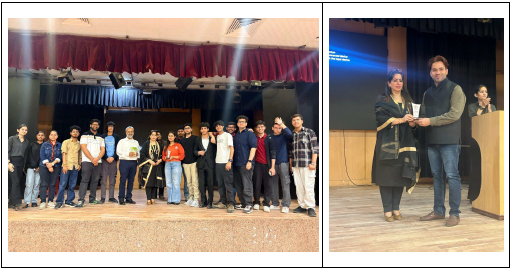
The second session, “Empathy in Business and Entrepreneurship,” was conducted by Mr.Shubham Chavriya. The session explained empathy as a strategic advantage in entrepreneurship. Participants learned about the three layers of empathy—cognitive, emotional, and compassionate empathy, which help entrepreneurs understand customer perspectives and develop meaningful solutions. Practical tools such as empathy mapping, persona development, and consumer journey mapping were introduced to analyze customer needs, experiences, and emotional responses throughout their interaction with a product or service.
The third session, “Survey, Ideation, and Observation,” was conducted by Dr. Naveen Rampal. The session focused on the discovery phase of innovation, where entrepreneurs gather insights about users through research techniques such as questionnaires, interviews, observation, and secondary data analysis. Participants were also introduced to ideation techniques, including brainstorming, reverse brainstorming, affinity mapping, and lateral thinking, followed by evaluating alternatives based on feasibility, impact, cost, and practicality.
Day 3: Design Thinking, Business Models, and Pitching
The final day of the workshop focused on applying innovation frameworks to develop practical business solutions.
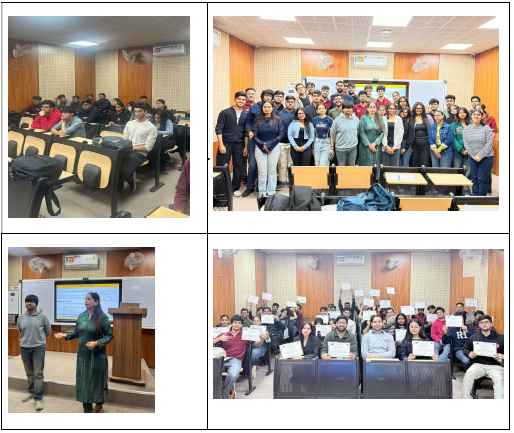
The first session, “Design Thinking: Principles and Process,” was conducted by Prof.Ravinder Kaur. The session introduced participants to Design Thinking as a humancentred
approach to innovation. Participants learned about the five stages of Design ,Thinking, Empathize, Define, Ideate, Prototype, and Test, and how this framework helps entrepreneurs create user-focused solutions.
The second session was conducted by Gourav Aggarwal, who introduced participants to Business Model Canvas Mapping. The session explained the nine components of the Business Model Canvas, including customer segments, value propositions, channels, customer relationships, revenue streams, key resources, key activities, key partnerships, and cost structure. Participants learned how these components help transform innovative ideas into structured and viable business models.
Conclusion
The “Foundation of Innovation” workshop successfully provided participants with valuable exposure to the principles of entrepreneurship, innovation, and design thinking.
Through expert-led sessions, practical frameworks, and interactive activities, participants gained insights into identifying problems, developing innovative solutions, and structuring sustainable business models.
Overall, the workshop helped participants develop creative thinking, empathy-driven innovation, and structured problem-solving skills, which are essential for entrepreneurial success and meaningful societal impact.
Report Prepared By:
Shubham Chavriya
Convener, Career Development Centre
Delhi College of Arts and Commerce
University of Delhi